
Engineering Insights
Deep dives on production AI systems, DevOps patterns, and the hard problems we've solved in the field.
AWS Bedrock vs OpenAI API: Choosing an LLM Provider
A practitioner's comparison of AWS Bedrock vs the OpenAI API — network isolation and VPC endpoints, compliance paperwork, cost structure, per-Region quotas, and model recency, from running Bedrock inside a zero-egress EKS platform.

Natural Language to SQL: Architecture for Conversational BI
A practitioner's guide to natural language to SQL — the six-stage pipeline behind conversational BI, why schema linking decides accuracy, and the guardrails and evals needed before non-technical users query live PostgreSQL.
Codebase RAG: Building Context Graphs for AI Coding Tools
A practitioner's guide to codebase RAG — why chunk-and-embed fails on source code, how to build an AST-backed context graph with Tree-sitter and Neo4j, and how to retrieve, rank, and keep it fresh in production.
Self-Hosted LLMs for Enterprise: A Deployment Playbook
A production playbook for self-hosted LLMs in the enterprise — the decision gate, a five-layer reference architecture on Kubernetes, GPU sizing and cost break-even math, and the four-phase rollout that gets a private model into production.
Deepgram vs AssemblyAI for Production Voice AI
A practitioner's comparison of Deepgram vs AssemblyAI for production voice AI — turn detection, streaming latency, deployment model and pricing structure, from running Deepgram in a 90K+ calls/month pipeline.
Healthcare Voice AI: Patient-Facing Agents That Stay Compliant
How to build patient-facing voice AI that passes a HIPAA compliance review — covering BAA-covered infrastructure, PHI handling in transcripts, and the escalation paths healthcare deployments require.

Voice AI for SaaS Products
A practical guide for SaaS founders adding voice AI to their product — the concurrency, cost, and multi-tenancy problems that only show up after launch, and the architecture that solves them.
Custom Clinical Trial Dashboards: Build vs Off-the-Shelf
A cost and capability comparison of custom clinical trial dashboards against off-the-shelf CTMS and EDC reporting — vendor pricing ranges, where packaged tools hit their ceiling, and what a custom build actually delivers.
What LLM Fine-Tuning Actually Costs (Build vs Buy in 2026)
A buyer's breakdown of what LLM fine-tuning actually costs in 2026 — managed API pricing, self-hosted GPU costs by method, data curation, and the engineering time nobody puts in the spreadsheet.
Voice AI Monitoring: Catching Failures in Production Voice Agents
The voice AI monitoring layer that catches failures pre-deployment evals miss — dead air, stuck sessions, STT/TTS provider degradation, and disconnect spikes — with detection signals and alert thresholds for each.
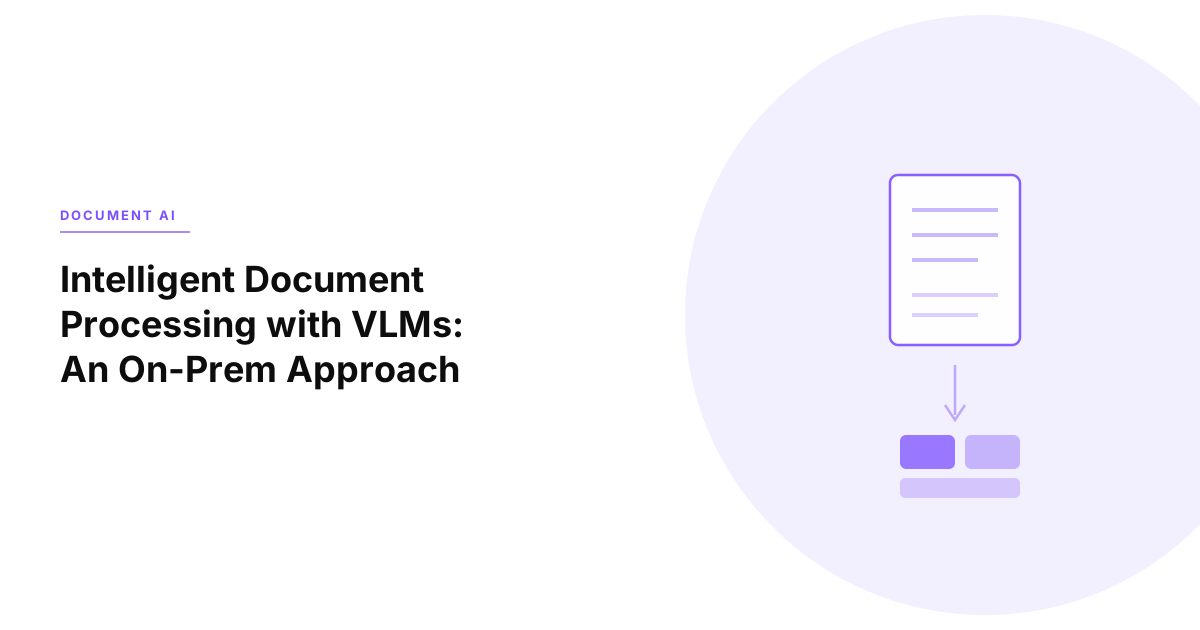
Intelligent Document Processing with VLMs: An On-Prem Approach
A production architecture for intelligent document processing that pairs PaddleOCR with Qwen2.5-VL — running entirely on-prem with zero network egress for sensitive documents.
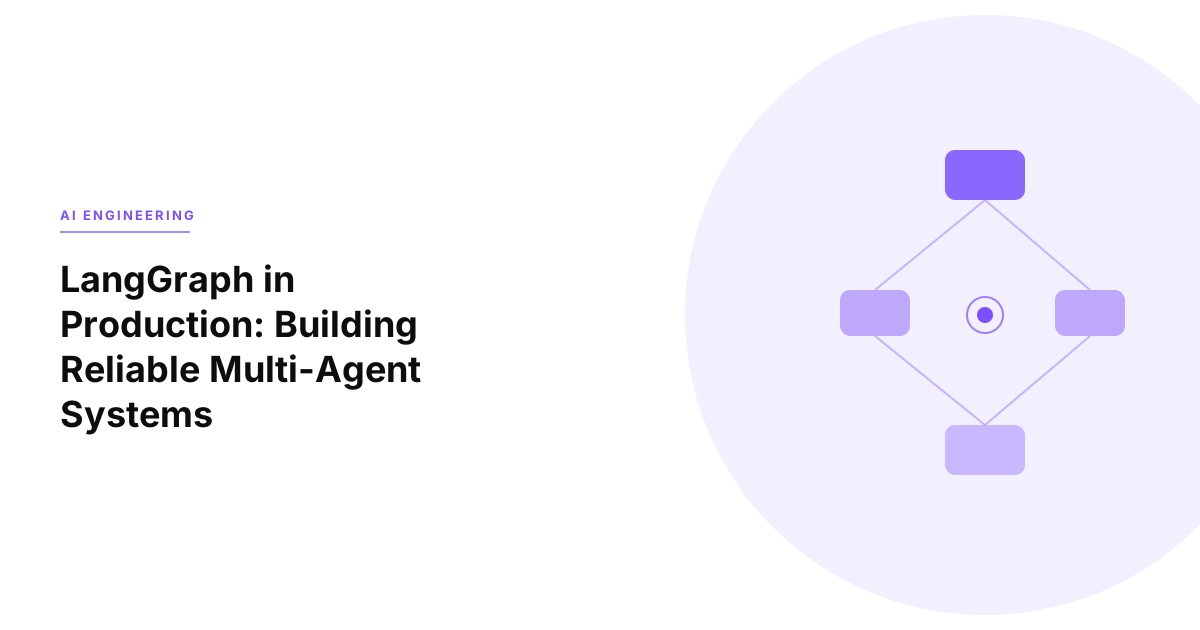
LangGraph in Production: Building Reliable Multi-Agent Systems
A hands-on guide to running LangGraph in production — checkpointer choice, decoupling graph execution from HTTP requests, supervisor vs swarm multi-agent patterns, and human-in-the-loop with interrupt().
Multi-Agent LLM Architecture: Orchestration Patterns That Ship
A production guide to multi-agent LLM architecture — the orchestrator-specialist pattern, mixture of agents, deadlock prevention, and the state-management patterns that keep large agent systems reliable.
pgvector vs Pinecone in Production: When to Choose Each
A practitioner's comparison of pgvector and Pinecone for production RAG systems — sourced benchmark numbers, Pinecone's real pricing structure, and the vector count where each architecture wins.
How to Detect LLM Hallucinations Before Users Do
A practitioner's guide to LLM hallucination detection in production — covering self-consistency sampling, reference-based scoring, RAG groundedness checks, and the quality-gate pattern that stopped regressions in a 10K calls/day voice AI system.
LLM Observability in Production: What to Log and Why
A practitioner's guide to LLM observability in production — the four things to log per call, Langfuse instrumentation patterns, custom quality score tracking, and the alerting layer that catches regressions before users report them.
Private LLMs for Regulated Industries: A Buyer's Guide
A practitioner's buyer's guide to private LLMs for regulated industries — covering the two deployment patterns, what compliance actually requires at the infrastructure layer, and a procurement checklist from a team that shipped air-gapped LLM infrastructure in 4 weeks.
Air-Gapped AI for Fintech and Regulated Finance
Prodinit builds air-gapped AI infrastructure for regulated fintech — private EKS clusters with zero internet egress, Bedrock via VPC endpoint, and compliant CI/CD — from a team that delivered a full production air-gapped stack in 4 weeks.
Stay ahead in AI engineering.
Get the latest insights on building production AI systems, be the first to explore approaches that actually work beyond the demo.
Start a Project →